Showing posts with label village. Show all posts

Thursday, February 13, 2014

Looking for Wildlife and Homelife on a Borneo River

Reading National Geographic Kids inspires my children to explore. In the same way that the original magazine got adults dreaming of adventures in faraway lands, the kid version has given my children a curiosity about the animals, landscapes, and cultures of our vast, diverse world.

Santubong, Sarawak, Borneo
Fisherman on the Santubong River, Borneo


When we boarded the boat on Borneo's Santubong River, my daughter was immediately enthralled by the wildlife photos lining the ceiling. Pictures of proboscis monkeys with their comical, Jimmy Durante noses stared down at us. Irrawaddy dolphins with their characteristic rounded heads and snub noses were shown frolicking in the water. Images of crocodiles glared at us, daring us to get a little closer. As the boat began to chug its way out into the river, she went on and on, telling me everything she knew about proboscis monkeys and their endangered status.

After a while, she paused for a breath and said, "Mama, we should go and see these animals sometime," waving her arm at the pictures

"Honey," I told her, "That's why we're on this boat. Those are the animals we're going to see!"

She was so surprised and delighted. The look on her face was akin to a preschool girl who has just been told she's going to DisneyWorld to have breakfast with all the Princesses. It was as if she had stepped into the pages of National Geographic. A world which had so far only existed on paper was suddenly about to become real.

We were going to see these animals in the wild. Of course, this can be a little trickier than seeing them at the zoo or aquarium. They aren't captive and waiting for you to come by to look at them. No, these animals are living free, and we needed a combination of luck and familiarity with their habits to find them. Luckily, we had a guide who knew a few tricks.

Santubong, Sarawak, Borneo
Waiting and staring, hoping to see proboscis monkeys.

Our first successful sighting was of some Irrawaddy dolphins. They are known to hang around fishing boats, so our boat would cut its motor and silently float whenever we came upon a fisherman.

"There!" someone would cry, pointing excitedly. The dolphins quickly came up out of the water and dove back down again. We would watch for a while before continuing down the river looking for more fishing boats to stalk.

Before you start scrolling down to see fantastic wildlife photos, I need to let you in on something. Photographing wildlife can be really hard -- perhaps even more difficult than taking pictures of uncooperative toddlers. Basically, none of my pictures turned out. All the ones of dolphins show nothing but water. I only got one photo of an animal the entire evening, and it was taken right as we were climbing on board.

Santubong, Sarawak, Borneo
Mudskippers are amphibious fish that use their pectoral fins to walk on land.

Yup, that's the sum total of all my successful wildlife photos. At least I have my memories...not that you can see them.

As we reached the mangrove forest, the boat took us closer to shore to look for proboscis monkeys. The key is to look for violently shaking branches. Night was approaching which is the time when these monkeys move from the inland spots where they spent the day back out to the river to forage for food. We spotted a few moving through the trees but never got the closeup look that we'd been hoping for. From what my friends tell me, we would have had a better chance of seeing them if we had spent the night at one of the Bako National Park cabins where the proboscis monkeys come crashing through the area every morning.


Santubong, Sarawak, Borneo
Fishing village on the Sanbutong River


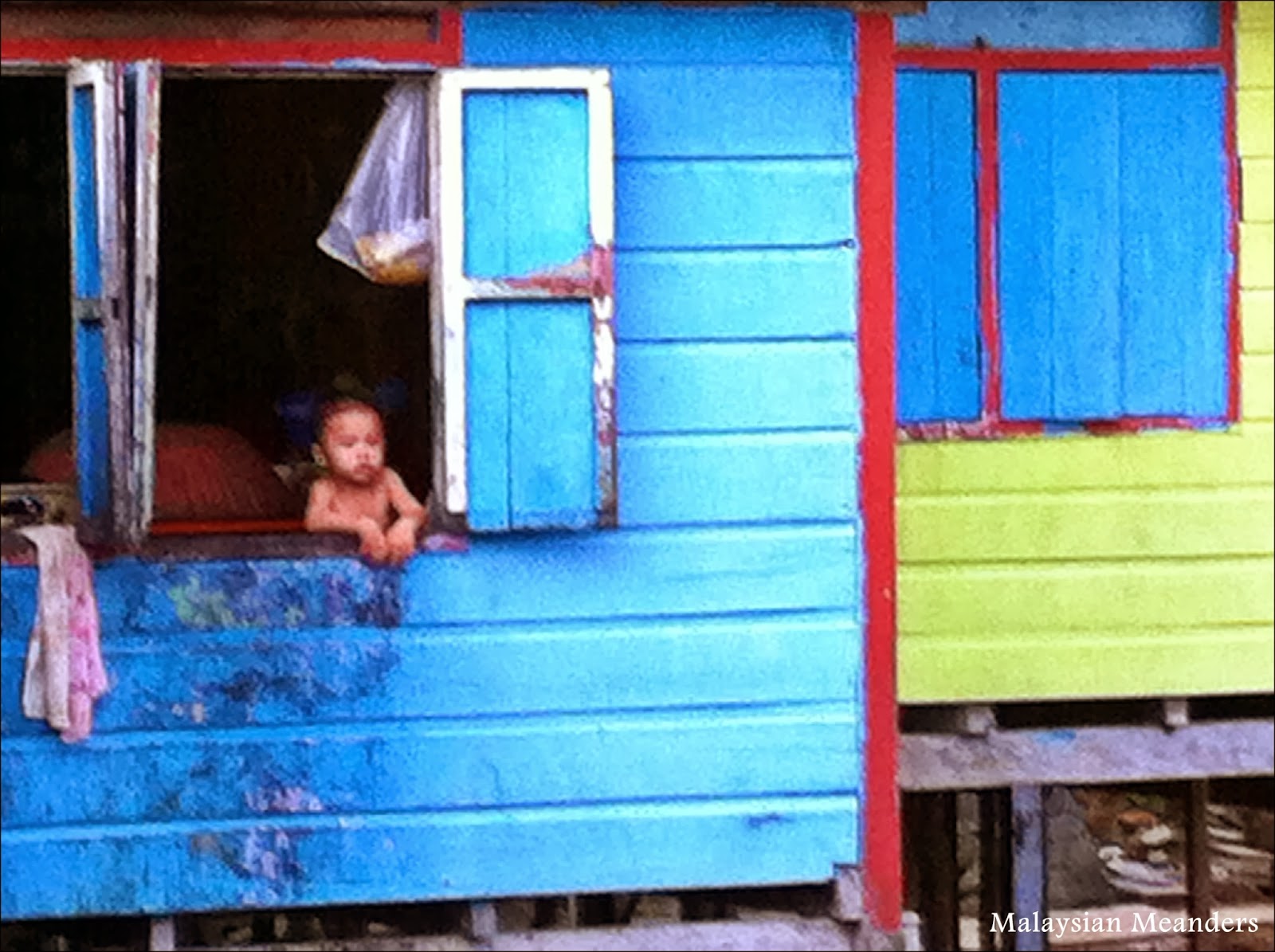
For me, one of the best parts of our river excursion was stopping at a Malay fishing village. The brightly painted houses were raised up on stilts to keep them out of the way of rising water. Boats were tied up all along the shore.

Santubong, Sarawak, Borneo
The fishermen have returned home for the day.

This place is so remote that they are not hooked up to a power utility. Instead, the loud drone of gasoline powered electric generators filled the air as we pulled up. There's a small school to serve the younger children, but teens interested in getting an education had to go elsewhere for classes, only coming home on weekends.
Santubong, Sarawak, Borneo
Toddler boy hanging out the window over the water.

The lack of power and secondary schools made me realize how different my life was compared to this fishing society. After all, I had reached their village on a 3-hour pleasure cruise and was going to lay my head down to sleep in a lovely hotel in Kuching that night. The fishing families, on the other hand, did not have the economic means to travel this distance often. Their poverty keeps them isolated.

Santubong, Sarawak, Borneo
However, they do have the money for satellite television.

The evening call to prayer was just about go out as we landed, so most of the footpaths were empty as wandered through the village. In fact, we never saw a man the whole time we were there as they were off praying. I did see a Winnie-the-Pooh baby blanket hanging up to dry, though.

Santubong, Sarawak, Borneo
Wooden walkways between homes lead down to the river.


Santubong, Sarawak, Borneo
One little boy dressed up in his Friday finery. 


Santubong, Sarawak, Borneo
The fanciest house I saw in the village.

We only spent a few minutes walking around. I actually felt a bit odd taking photos, wondering what I would think if some stranger stood a few feet from my home taking pictures of it.

Santubong, Sarawak, Borneo
Sunset from the fishing village

As the sun began to set, we got back on board for our return trip. The guide shone his powerful flashlight at the mangrove forest's shoreline, sweeping its beam back and forth. He was looking for crocodiles whose eyes reflect the light, making them glow in the dark. My girl was the only person to see a crocodile (or so she claims).

We ended the evening cruise floating by a couple trees filled with fireflies blinking on and off. Fireflies are pretty much impossible to photograph in the dark from a bobbing boat. While I remember seeing fireflies on summer nights when I was a kid, this is the first time that my own children have seen them. I wonder if the fireflies are dying off in Houston, Texas as my parents still live in my childhood home, and the fireflies no longer flit through their yard.

All of us were quiet on the 40-minute van ride back to Kuching. It's excursions like this that make me fully appreciate all that travel can show my family. Wildlife transforms from being something we read about in books or visit in captivity to something that we see in its natural habitat. We're introduced to people whose society is physically located close to our own modern world yet remains so different from ours. We weren't just flipping through a copy of National Geographic. We were experiencing it in real life.


IF YOU GO:
We booked our tour through CPH Travel Agency. They picked us up from our hotel in Kuching in an air conditioned van and provided fruit snacks and non-alcoholic beverages on the cruise as part of the tour. The boat had life-jackets if you elected to wear one, even ones small enough for preschoolers. The cost was a little more than US$50 for adults and US$25 for children.

RELATED POST:
Don't Anger the Orangutans


This post is part of Travel Photo Thursday on Budget Travelers Sandbox, "Oh the Places I've Been" on The Tablescaper, Sunday Traveler on Ice Cream and Permafrost, and Travel Photo Mondays on Travel Photo Discovery. Check them out form more around-the-world travel inspiration.

Wednesday, April 10, 2013

Visiting the Long Neck Tribe


These girls have worn neck rings for just a few years. More will be added as they get older.
My daughter lives such a different life than them.

I remember sitting in my suburban Texas home when I was a little girl and reading about the Long Neck Tribes in the remote jungles of Asia. Looking at the explorer journal sketches of women with rings going up their impossibly tall, giraffe-like necks, these people seemed no more real than the inhabitants of Tatooine, Narnia or Middle Earth -- maybe even less so. They were so far removed from my life in the land of cowboys and astronauts. I certainly never thought that I'd one day encounter them face to face.


Baan Tong Luang is an eco-agricultural hill tribes village just outside Chiang Mai, Thailand. It was created in 2005 as a cultural preservation project, tourist attraction, and a way to create income for the hill tribes, many of whom are refugees from Myanmar. Seven distinct tribes are located here including the Padaung people, also called the Kayan Lahwi, a subgroup of the Karen tribe and famous for their women with long, ringed necks. 

Uncurling the rings of the Padaung women


At first, I was hesitant to visit. What if I was contributing to the perpetuation of an outdated custom maintained merely to separate tourists from their money? I wondered if it would feel like a Human Zoo. But then I decided that I never question visits to Australian Aboriginal Cultural Centers, Colonial Williamsburg or other living history museums. Perhaps I should give them the benefit of the doubt and assume that these tribes kept their traditions alive out of pride and wanted to share them with the world.

Brass rings encircle her neck, wrists, and legs
Does she long to remove them or is it an integral part of her cultural identity?
Does she wish people would see past the rings to the individual inside them?

I'm so glad that I went. I got to talking with one of the Padaung women, thrilled by how well she spoke English as my Tibeto-Burman language comprehension is quite poor. After chatting with her, I no longer felt like a mere voyeur but instead like someone who heard her story and carried it out to the world. We asked her what it felt like to wear those rings. "Heavy and hot," was her answer. "But it is better here," she said. "When I worked in the fields in Burma, they were so hot. It was hard to work. Here, I can weave and sit in the shade." She unfurled some of her handiwork. Each one takes 3 days to weave and are priced at only US$5. After listening to her story, I didn't  have the heart to haggle. Like most girls, she started wearing the rings when she was about 4 or 5 years old, beginning with just a few. Now, she has 25 rings. (The rings do not actually stretch their necks but squash their vertebrae and collarbone so it angles downwards, giving the illusion of a longer neck.) In this woman's case, she did not start wearing rings just to draw tourist dollars. Perhaps this village did indeed provide her with a better, easier life after fleeing the turmoil in her homelands seven years ago. She also mentioned that she cannot leave Thailand because she has no passport.

Weaving is better than fieldwork.
Her white shirt signifies that she's unmarried.

One of the tables held postcards of a young Padaung lady dressed in modern clothes. With her hair flowing loosely down her back and a contemporary jacket, the neck rings took on the look of a bold, statement necklace. It's a look that the fashion world would approve of.

This perfume ad with Charlize Theron in the in-flight magazine
definitely reminded me of the Padaung women.

This village is not just some place for their day job catering to tourists. They live here, too. Rice paddies line the walk in the middle of the village while water buffalo graze off to the side.

Top: Livestock of water buffaloes and roosters
Middle: Rice paddies
Bottom: Houses on stilts and their makeshift sink comprised of a hose and bucket


A small one-room schoolhouse provides the children with a few hours of education each day, more on weekends. I noticed that working age men and older children were missing. Perhaps they go out and earn other income during the day.

A Community Education Development teacher from outside the tribe comes by to teach them Thai, English and Burmese.


Surprisingly, the village path ends in a Catholic church at the top of the hill. While the hill tribes were originally animists, many are converting to Christianity after meeting missionaries.


St. Nicholas Church at the end of the village

Other northern Thai hill tribes live in this village as well. For the most part, it's a big market selling goods that the villagers make along with outside handiwork. No guided tour, lectures, or performances are part of the experience. Since admission is 500 Thai baht, they don't do high pressure selling or charge you for photos. Haggling is acceptable, although my husband teased me about how horrendous I am at it.


Another branch of the Karen tribe who do not adorn their necks with rings are at the front of the village. Originally from Tibet, they moved into China and then Myanmar (Burma). In the last few decades, political turmoil caused them to take refuge in northern Thailand.

Karen woman weaving on her backstrap loom.
Married women wear bold colored shirts.

The Kayaw are another subgroup of the Karen tribe. Like the long necked Padaung subgroup, their legs are also encircled with brass. However, their necks are adorned with loose necklaces instead of confining rings.

Kayaw girl reads while mom weaves.

Kayaw section of the eco-agricultural village


The Lahu Shi Bala is another tribe that originated in Tibet and moved down to China, then Myanmar, Laos and Thailand. Their women insert big metal earrings into their earlobes. My kids really enjoyed trying out the handmade cross-bows with the elder males of this tribe.


Lahu Shi Bala grandmother tending to the baby in the hammock.

Lahu Shi Bala man demonstrates an instrument made out of a gourd with bamboo pipes emerging from it.


The Palong tribe is a minority tribe that immigrated from Myanmar to Thailand in the mid-1980's. When I first approached the children, they were happily playing. As soon as one girl saw my camera, she called the others to sit down and pose.

Palong children

Palong woman selling hats and elephant bullhooks


The Mien or Yao people are from central China but have been in Thailand for about 150 years. "Yao" means "not under the power of anyone." This was the only tribe I saw doing needlework and batik.

Top: Mein woman doing needlework; Hot coals keep the batik wax liquid
Bottom: Batik tool for applying wax to cloth. Those evenly spaced lines are drawn by freehand.

 IF YOU GO:
  • Baan Tong Luang  Eco-Agricultural Village is located off Maerim-Samuang Road, about 35 minutes from the old walled section of Chiang Mai.
  • In some ways, this place is merely a large marketplace. Turn it into a deeper experience by taking time to talk with the villagers. They want to share their stories. Feel free to take photographs.
  • Allow 1-1.5 hours for your visit, depending on how much time you spend talking.
  • Bring drinking water.
  • Admission is 500 baht for adults and 300 baht for children
  • Pair this visit with excursions to other area attractions: Queen Sirikit Botanic Garden, Mae Sa Waterfall (a favorite among locals for picnicking and cooling off), or one of the many nearby animal encounters (Mae Sa Elephant Camp, Tiger Kingdom, Monkey School, or Siam Insect Zoo).


Related Post:
Dirty, Hungry Elephants
Longing for a Chiang Mai Wet Market
Chiang Mai Sunday Market
The Ruins of Chiang Mai's Chedi Luang Temple


This post is part of Travel Photo Thursday on Budget Travelers Sandbox, Pret-a-Vivre, and Friday Daydreamin' at R We There Yet Mom? Check them out for more around-the-world travel inspiration.

Web Analytics