Showing posts with label festival. Show all posts

Thursday, March 26, 2015

Exploring the EPCOT International Flower and Garden Festival

EPCOT, monorail, DisneyWorld, Disney
The decorative berm on the slope surrounding the waterway is covered with 76,000 individual plants for the festival.
225 garden islands of colorful impatiens float in the waterway.


How excited was I about the EPCOT International Flower and Garden Festival? To infinity and beyond. Beyond excited. I've always wanted to attend, and coincidentally, our Spring Break visit was during its multi-week run that ends May 17. Sure, Disney does a fantastic job of keeping its parks pretty throughout the year, but they really step it up a few notches at EPCOT during the festival with the addition of over 200,000 new plants. Flowered berms replace grassy hillsides and large topiaries stand proudly in flower beds. As an extra perk, additional food booths pop up around the World Showcase, and a few playgrounds are added in Future World. 

Saturday, November 2, 2013

Little India Preps for Deepavali

Little India is bustling right before Deepavali

Happy Deepavali! The Little India section of George Town, Penang is always a vibrant and bustling feast for the senses. In the week leading up to the Deepavali (also called "Diwali") celebration, everything is amped up a bit. The crowds are bigger, the stores are busier, and the Bollywood music blares from large speakers out on the sidewalk. Most stores have open fronts, and their merchandise displays extend on to the street. As you stroll through Little India, it's easy to see what everyone has to offer without having to stop to poke your head through a door.

Deepavali is a five day "festival of lights" and quite important in the Hindu religion. Traditionally, a row of lamps is lit to signify good's victory over evil, and people celebrate by shooting off fireworks to ward of harmful spirits, wearing new clothes, and sharing sweets with each other. As I write this, firecrackers have been going off all night on the streets below my home.

Delicious sweets from Sri Ananda Bahwan


Last Monday, I dropped the kids off at school a mere 12 hours after our return from our trip to China and Tibet. In the school parking lot, I ran into a friend who invited me out sari shopping in Little India that morning. Hmmm.. go back home to unpack and do grocery shopping or hang with my friends to go shopping? The decision was not difficult.


Dosai and Saris
Note that the Dosai is almost as long as the table.


Our first stop was Woodlands Vegetarian on Penang Street to fill up on Paper Dosai, a paper-thin pancake made of fermented rice batter and black lentils, served with masala potatoes. To say that my friend ordered the Large size would be an understatement. Afterwards, we headed down the block to Maya Silk Centre to check out their sari cloth collection. As Mr. Rajan pulled out one beautifully embroidered silk after another, we quickly became overwhelmed by the selection. His shop was quite busy that week finishing orders for Deepavali, but by next week, he could make our custom saris in as little as an hour. Thankfully, he could also hide Velcro and hooks in the folds of the fabric so we wouldn't have to rely on our Indian friends to come over and dress us whenever we wanted to wear it. After mulling over the vast selection, we decided to come back post-Deepavali to figure out what we wanted.

A little shop on the corner of Penang Street and Market Street


On Thursday, I found myself back in Little India for a walking tour with Teresa from the Penang Heritage Trust and organized by Spiral Synergy. Teresa was part of the committee instrumental in getting part of George Town named a UNESCO World Heritage Site. I had no idea that they were rejected 8 times before getting the recognition. I commend them for persevering and bringing the charms of George Town to the attention of the world.

Indian Treats from Thali NR Sweets on Penang Street


This day began with a traditional Indian breakfast at Sri Ananda Bahwan or SAB as it is affectionately called. While the open kitchen has become a trendy concept with swanky restaurants,  SAB has had an open kitchen for a long time. With griddles positioned at the front of the restaurant, people walking by on the sidewalk can easily be lured in by watching the cooks spread out elongated ovals of dosai batter or flip Roti Canai dough around in the air to stretch it out.

Making delicious Dosai and Roti Canai by the sidewalk


Afterwards, we headed to a small beauty centre to watch a demonstration of threading and henna art. Threading involves removing unwanted hair by twisting thread around each wayward strand and yanking it out. According to Teresa, it's better than using tweezers. In either case, ouch! Although, I will admit that it's rather a bargain at US$1.70 a visit. Henna tattoos are created by squeezing natural dye from the henna plant out of a small cone and onto the skin. After leaving it on for a few hours (careful of smudging), you wash it off and have a temporary design that will fade away over the course of a few weeks.

Applying henna to make a temporary tattoo.
The finger in the background has the color after the dye is washed off.


Then, it was off to visit a sari shop. It turns out I was headed back to Maya Silk Centre. We learned how to tell "art silk" with a polyester blend apart from real silk. Let's just say that setting fire to a store's merchandise might put you on the bad side of the shop's owner. I think I may have also found a gorgeous georgette which is much more affordable than silk, US$30 versus US$100, that I may have made into a custom sari for myself. Most of the tour group could have easily spent the rest of the morning shopping for saris and Punjabi suits, but Teresa pushed us out of the store so that we could stay on schedule.
 

Gorgeous silk sari cloth with Swarovski crystals and gold thread


Our next stop was a spice shop further down on Penang Street called Mohamed Meera Sahib. The savory smell of curries mingled with other spices wafted out onto the street. Early in the morning, this store was packed with customers. I could barely move. Tubs of powdered spices sat at an angle along one side while sacks of lentils, dal, cinnamon and star anise sat around the scale. On the shelves, I saw tin after tin of Ghee and solid chunks of Gula Melaka palm sugar. It smelled heavenly in there. Teresa scooped up handfuls of each item and told us how they were used. Some were even in the breakfast we had dined on that morning.


Spices are historically an important part of George Town's heritage

After we exited, we turned left to head down Market Street towards a lovely shop where ladies can find all sorts of accessories to dress up their outfit, hair, and faces. Stick-on Bindi dots above the nose can signify a woman's married status if it's big or just a beauty mark if it's small.  I was particularly drawn towards the stacks of golden bangles and the elaborate necklaces. So pretty!

A variety of adornments in this shop
 

A streetside flower stall a few doors down was making garlands with fresh flowers from the Cameron Highlands. Some blooms were their natural colors while others had been dyed a brilliant hue. Hindus purchase these flowers and take them to the temple or one of the nearby altars as an offering.

Lush garlands are used as offerings at Hindu temples and altars.

We made it to Queen Street's Sri Mariamman Temple, the oldest Hindu temple in Penang, just in time for a blessing before it closed at noon. I've always wanted to go in and look around but have been a little intimidated by my worry that I would ignorantly do something offensive. With our guide, Teresa, there, I wasn't worried and listened carefully to her explanations of the various statues inside the temple. At the end, she received a blessing from the Hindu priest.

A blessing on your head

With all the scents of street food floating through the air, it was hard to ignore the rumbling in our stomachs. We sat ourselves down on a plastic stool at a streetside table and watched a man prepare Teh Tarik, "Pulled Tea." To quickly cool hot tea, streams of the sweet, milky brew are poured back and forth between two cups, starting with them close together and then pulling one higher and higher into the air. Veggie Samosas from the stall across the street provided some yummy noshing, too. Teresa also recommended the buffet style Nasi Kandar meals at Restoran Tajuddin Hussain on Queen Street near the temple as being an important combination of hygienic, frequently replenished, and tasty.
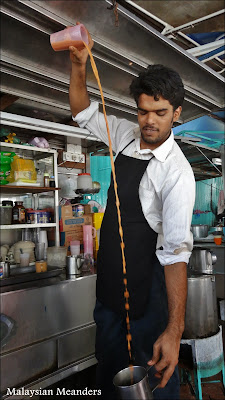
Making Teh Tarik "Pulled Tea"
 
 
Veggie Samosas, only US$0.33 a piece

With my hunger sated, I peeled of from the tour and made my way back to the car. Even though it was only noon, the streets of Little India were packed with people. What I had mistaken for a pedestrians only street was actually open for vehicular traffic, and cars slowly made their way down the road with the crowds parting before them. This part of town is certainly busy during the festive Deepavali season.

People were eager to buy a new outfit for Deepavali. Perhaps a Punjabi Suit?

The rest of Penang is happy to share in the Deepavali celebration, too. It's not just limited to Little India. Shopping malls and office buildings will decorate the floor with a kolum, an intricate design made of colored rice, that is also known by the name "rangoli." They are sacred welcoming areas for Hindu deities and are meant to bring good luck.

Rangoli at Straits Quay


A closer look at the colored rice kernels of the rangoli

Here's wishing you a very Happy Deepavali!


Related Posts:
 
 
This post is part of Travel Photo Thursday on Budget Travelers Sandbox. Check it out for more around-the-world travel inspiration.


Thursday, September 19, 2013

Glowing Lanterns, Tasty Mooncakes, and the Mid-Autumn Festival

This post is dedicated to my mama. Thursday, September 19 marks this year's Mid-Autumn Festival celebrated with glowing lanterns and tasty mooncakes.

A variety of Mooncakes - Coconut, Starbucks Coffee and traditional Lotus Paste


Growing up, the Chinese custom of eating mooncakes is one of my cherished memories. At the time, Houston's Chinese population had yet to explode, and I felt like part of a secret society since, as far as I could tell, we were the only family who did this. My mother was born and raised in the Philippines. Despite never having set foot in China, this tradition is something that had been passed down from my grandparents through her, to me. I'm not sure where she procured them. Perhaps the Mooncake Supplier hung out with the Tooth Fairy, Santa Claus and the Easter Bunny and blessed my mom with these pastries as a reward for being a good Chinese mama all year. She'd get really excited whenever someone would visit from Asia, Canada or California and brought her a box. I suppose these were a little fresher than whatever she could buy in Houston. We would just have one or two for our family of four, and she'd slice these palm-sized pastries into little wedges for us to share.

According to my mom, mooncakes are part of the Feast of the August Moon, occasionally called the Feast of the Harvest Moon. I would usually point out that it was September, sometimes early October, but never, ever August. My child brain may have chalked this up to a major time zone difference. California is two hours behind Texas, and Asia is a whole month behind. Later, I understood that it fell on the full moon of the 15th day of the eighth month of the lunar calendar, not the Gregorian one I was taught in school. Even back then, I learned that just because something is different doesn't mean that it's wrong, a notion that would come up quite often in my adult, expat life.

Shortly after I arrived in Malaysia, I was amazed to discover that this "secret" tradition is wide-spread here. Pining for home a little bit, it was a shred of something familiar from my childhood.  In Malaysia and Singapore, it seems that everyone refers to it as the Mid-Autumn Festival or, less frequently, the Lantern Festival (not to be confused with China's version of the Lantern Festival which occurs during the first month of the lunar year).

Last weekend's trip to Singapore's Gardens by the Bay coincided nicely with the Mid-Autumn lantern celebrations they were holding. I have not seen anything on this grand scale anywhere in Penang.

A life-size house lantern floating on the lake

Lots of people came to Singapore's Gardens by the Bay to look at these large lanterns.


Something for the kids to enjoy

One of the winners of the lantern making contest


Mooncakes are all over the place in Penang. There's big displays at the mall, local bakeries and restaurants make them, and they're readily available at the grocery store. It was no longer a rare commodity. My Zumba instructor handed them out after Tuesday's class, and a friend had a box to share at the school playground. She said that it's traditional to exchange them with each other or bring them as a hostess gift when invited to someone's house.

I was raised on the traditional Lotus Paste with a Single Salted Egg Yolk mooncake. I brought one into my workplace in Texas once since it was staffed with adventurous foodies, and one friend described it as having a taste reminiscent of marzipan.  My hubby and kids don't really like them because, being a Chinese dessert, they only have a hint of sweetness, not the tooth-achey sugar rush you get from American pastries. Unfortunately, they are very high in calories.


Traditional Lotus Paste and pumpkin seed filling
No salted yolk because I always pick it out.


Oh my goodness, the varieties you can get over here! Malaysia offers an endless list of flavors from Pandan to Green Tea to Cookies and Cream. Even Durian filling is available. My favorite non-traditional flavor this year is Coconut which reminds me of Filipino Bibingka but with shreds of coconut throughout and no cheese.

Mooncakes are made by wrapping the filling around a cooked, salted egg yolk representing the moon and then wrapped with the outer pastry layer. Each assembled piece is pressed into a wooden mold to create the decorative impressions and then removed before baking. The round cakes are a symbol of family unity and good health. Somehow, the Skype session between my mom and I a few weeks ago ended with us each brandishing our own mooncake molds at the web camera. I'm not quite sure how that supports family unity.


Mooncake mold

Same shapes are specifically designed to appeal to kids. Sponge Bob or Mickey Mouse, anyone?

Chocolate Mickey Mouse mooncake


Whereas Starbucks aims to deliver the same espresso drinks no matter what store you are at in the world, they do offer special items that cater to the local palate. If you ever come across an Asian Dolce Latte, try it. It's like Vietnamese coffee and so very yum. In Malaysia and Singapore, they also sell mooncakes. In fact, the Caramel Macchiato and Tiramisu fillings they offered two years ago are probably my favorite of all the nouveau flavors I've sampled since moving here. Alas, their mooncake menu has changed, and these primo fillings have not reappeared.

Notice the Starbucks logo on top of their Tiramisu mooncake.


I was also introduced to Snow Skin mooncakes. Unlike traditional ones which are baked with a pastry outer crust and served at room temperature, snow skin mooncakes are not baked and have an outer layer of glutinous rice, similar to that in Japanese mochi ice cream. These have to be kept refrigerated, are served chilled, and are perceived as a healthier alternative to traditional mooncakes.

Strawberry Snowskin mooncake


Other international chains have joined in the mooncake frenzy and offer their own interpretations of this treat. Haagen-Dazs offers one with a praline base, ice cream filling surrounding a mango sorbet "yolk" and covered with a  hard chocolate shell.


Ice cream mooncake


Godiva Chocolatier sells one that's essentially a large chocolate candy. I know that you readers are desperate to know what one tastes like, so I bought one for the sake of the blog. The Duo Lait version has a top layer of milk chocolate ganache with hints of mandarin and red cherry and a punch of cinnamon and sea salt sitting on a bottom layer of California almond praline. It also costs about US$2.50 a bite. Pricey!

Godiva mooncake


By this time next year, I'll probably be back in Texas, so I'm enjoying all the mooncake madness while I can. Have you ever tried mooncakes?


This post is part of Travel Photo Thursday on Budget Travelers Sandbox and "Oh, the Places You'll Go!" on The Tablescaper. Check them out for more around-the-world travel inspiration.

Friday, April 13, 2012

Penang's Thai New Year Songkran Water Festival

Wat Chayamankalaram Thai Buddhist Temple

Today kicks off the New Years Celebration in both Thailand and Myanmar. In Thai, it's called "Songkran," and in Burmese, it's "Thingyan." The primary way to celebrate is by throwing water on each other. Doesn't that sound like the perfect way to cool off on a hot day? In Penang, the Thai Buddhist Temple and the Burmese Buddhist Temple sit across the street from each other which makes this place the center of action.

Wednesday, February 15, 2012

Now that's a lot of Body Piercing! Thaipusam in Penang

That is not a shirt. It's multiple body piercings.

Warning: This post is not for the faint of heart. But if you've already looked at the first photo, you might as well proceed.

Back in Austin, I knew quite a few people with body piercings where I used to work. On the tamer end of the scale was anyone with multiple ear piercings or belly button rings. The lovely receptionist had a few rings going through her eyebrow with a thin chain connecting them to the piercings on her earlobes. During meetings, I could sometimes hear the clack-clack-clack noise of another coworker running the tiny barbell in her tongue back and forth across her teeth. One man had pierced his belly button, nipples and nether regions (although no one independently confirmed the last one). Are you thinking that I worked at some club or bar? Nope! It was a biotech company.

Anyways, these people had absolutely nothing on the rows and rows of body piercing I saw at Penang's Thaipusam festivities. It was quite a sight. In the picture above, all those silver urns covering the man's torso and arms have been hooked directly into his skin. Dozens more hooks covered his back. The man would occasionally stop and lean forward, pulling the ropes taut to add more discomfort (to put it mildly). From the front, I could see he had at least eight sets of chains and hooks draped across his face.

Thaipusam is one of Penang's biggest Hindu celebrations and also a public holiday. This being the multi-ethnic country of Malaysia, it overlapped with the the last day of Chinese New Year as well as the Islamic observation of Prophet Muhammad's birthday. Thaipusum marks the triumph of good over evil when Lord Murugan received a spear and defeated an evil demon.  I first heard of it when I was researching our trip to Batu Caves in Kuala Lumpur which has an even bigger crowd for the occasion.

The festival starts in Little India with a beautiful, silver chariot carrying a statue of Lord Murugan along an all-day, 10-kilometer pilgrimage to the Nattukkottai Chettiar Temple on Waterfall Road. To symbolically cleanse the chariot's path, devotees walk ahead of it smashing coconuts on the road. I didn't go to this part of the celebration, but a friend who witnessed it tells me that a mini bulldozer followed the chariot, pushing the shells aside to literally clean up after the symbolic cleansing. Apparently, coconut smashing can only occur during approved times.


Hubby and I joined in on the activity closer to the temple. As we approached, I could hear the loud music and rhythmic drumming. The scent of incense and savory spices from the snack stalls mingled in the air. It was definitely a festival atmosphere — lots of people and food, souvenirs for sale, and Angry Bird balloons. Those birds are popping up everywhere.


Numerous companies and families set up booths along Waterfall Road to offer drinks and nourishment to the devotees. HEB was a major sponsor. No, not the Texas grocery store chain. I'm referring to the Hindu Endowment Board.


Intel's Thaipusam booth.
I bet they don't have this at their Santa Clara, California headquarters.

Forget your offering of milk and sweets? No worries. Pick some up here.


Beautiful sidewalk chalk drawings lined the road, too.

All along the road, devotees of Lord Murugan carried kavadis, or physical burdens, to offer up to him as penance, thanksgiving, or in supplication. The simplest kavadis are urns of milk carried upon the head. Others kavadis are tall portable altars decorated with peacock feathers. They are balanced upon a man's shoulders and hips and then connected to him with hooks piercing his skin.


Woman with milk urn on her head in front and a two giant kavadis behind her.


 I wanna see your jaw dropping, eye popping, head turning, body shocking peacock kavadi.


The biggest burden is the multiple body piercings. Sometimes a spear representing Lord Murugan's weapon threads its way in one cheek, through the tongue, and out the other cheek. The piercings are done in front of a public crowd in Little India before the pilgrimage begins and removed after the offering is made at the temple.

I am truly amazed by how devoted these people are. It makes my promise to give up chocolate for Lent kind of lame in comparison. But hey, that's just how I roll.


Related Posts:
Kuala Lumpur: Temples and Caves


This post is part of Photo World Mondays on Travel Photo Discovery. Check it out for more visual delights.
Web Analytics