Thursday, March 6, 2014

Great Wall of China Toboggan Ride

Whenever my kids go to one of those upscale ice cream shoppes, their eyes grow wide, and they start asking for everything. What starts out as a simple outing to get a scoop of ice cream turns into a Bambi-eyes request for the ice cream and the mix-in and some hot fudge sauce on top.

Mutianyu
On the Great Wall

That's kind of what our visit to the Great Wall of China turned out like. For many folks, visiting the Great Wall is a bucket list travel aspiration. Just getting to the Great Wall is enough. But thanks to my kids' circle of well-traveled classmates, they knew that the Great Wall had more to offer. There was no need for me to go online to figure out ways to make the excursion exciting for children. Asking around on the playground was enough. One activity kept coming up over and over again.

Slide down from the top of the wall on the toboggan run. 

Mutianyu, slide system, luge
Oh yeah, a visit to a Wonder of the World and a toboggan ride

What's up next? Water slides down the Pyramids of Giza?

How about getting up to the top? In all my Great Wall daydreams, I am already standing on the wall. I never considered how I would actually arrive there. Should we walk up? Goodness sakes, no way! 

Ride up on the cable car or chair lift.

Great Wall of China, Mutianyu, gondola
Enclosed Cable Cars from the parking lot to the top 


So, this little bucket list item turned out to be visit the Great Wall and go up on a chair lift and ride a toboggan down. Can you see why the kids were excited? It's as if we went into that ice cream shoppe and said triple scoops, mix-ins, fudge sauce, and chocolate-dipped waffle cones for everyone.

Visiting the Mutianyu Section

We drive about 1.5 hours from Beijing to reach the Mutianyu section of the Great Wall. This 2.3 km stretch is the longest restored section of the wall, and everything I read indicates that it's less crowded than the other sections closer to Beijing that are open to tourists. A tamped earth wall was built here in the sixth century, but it was upgraded during the Ming Dynasty (1368-1644 A.D.) to a granite fortification with 22 watch towers spread out approximately every 100 meters.

As we pull into the car park, I gaze upwards at the wall snaking its way across the mountain pass about 100 meters above us. To get to the ticket office, we walk through souvenir stalls selling all sorts of Chinese memorabilia including the "I climbed the Great Wall of China" T-shirt that I buy my daughter at the end of our visit. (A week later, I regret not washing this black shirt separately from the rest of the laundry as I pull out a load of now-grey clothes from my washing machine.) 

Great Wall of China, Mutianyu
Souvenir stalls

At the bottom, we have three choices for getting up to the wall.
  • Walk up the footpath with 4000+ steps for 30-40 minutes
  • Ride the enclosed cable car up to Tower 14 with option for return ticket down
  • Ride the chair lift up to Tower 6 which includes toboggan ride down
Tip: The cable car and the chair lift are operated by different companies. If you plan on going up on one and returning to the bottom on another, buy both tickets before heading up to the wall.


Going to the Top

We decide on the chair lift and hop on. During the 10 minute ride upwards, I look around taking in the view. The surrounding mountains cloaked with autumn colors on this late-October afternoon are a sight to behold. After the bustling crowds of congested Beijing, Mutianyu is relaxing and literally a breath of fresh air.

Great Wall of China, Mutianyu
Riding on the Chair Lift


Finally, we are on top of the wall. Jump for joy! This Great Wall moment is one of the reasons why I desperately wanted to visit China and was willing to go through all the hassle of applying for a visa... and getting rejected, reapplying, and paying the ridiculous rush fee despite having turned in the paperwork weeks beforehand.


Walking on the Wall

While the restored Mutianyu section of the Great Wall has a mostly smooth walking surface, there are still stair steps as it follows the ridgeline up and down. Lots and lots of steps. Merely getting from Tower 19 to Tower 20 involves 450 steps. In other words, don't bother bringing a stroller for your little one. 

The Great Wall stretches far into the distance


Here, the Great Wall stands 7-8 meters tall and is 4-5 meters wide. This width supposedly enabled a large number of troops and messengers to pass through the route, but I'm thinking that the steps and the narrow doorways of the towers probably served as bottlenecks. This section is unusual in that it has crenelations on both the inner and outer walls, allowing soldiers to fire on the enemy who were approaching as well as those who had breached the wall.

The end of October turns out to be a beautiful time of year to visit. The crowds from Golden Week earlier in the month are gone, and the trees are changing colors. Perhaps being a soldier stationed on the wall was not so bad if you got to stare at this all day.

The view looking north east from the wall

The summertime is reputedly hot and more crowded with foreign tourist. My son's friend walked the wall one winter and declared it "the coldest he's ever been." One of my mama friends visited in late March and was surprised to encounter snow. While her older kids enjoyed the sight of their first snowfall (and the younger one cried about freezing toes), they were disappointed to discover that the toboggan run closes when it's snowing, raining, or for other bad weather conditions. 

Great Wall of China
Mountains start to fade away

I rein in my teen boy while we are up there. Faced with all this expansive scenery and the top of the Great Wall stretching out before him, all he wants to do is run. He longs to go up and down steps from tower to tower as fast as he can. Instead, he has to make do with going no more than one tower ahead and waiting while the rest of us caught up. Poor guy, because this mama is quite slow, stopping to take photos every few steps.


Exploring Watch Towers

Tower 5 of the Mutianyu section has a covered 2nd story

Most of the watchtowers are a single story with stairs leading up to the open rooftop. Tower 5 is unusual in that the 2nd floor is also covered. Back when the Great Wall was still in use as a defense system, lookout guards were stationed on the towers. If they spotted attackers approaching, they lit a signal fire on the roof to warn the surrounding towers. Since the towers were built on hilltops, it was easy to see the smoke during the day or firelight at night. Any guard who saw a signal fire built his own fire in order to pass along the message to alert the troops to ready for battle. Lanterns on poles and flags were other ways to communicate between towers. 

Great Wall of China, Mutianyu
Looking out from a watch tower

The average Chinese man is shorter than his Western counterpart. Plus, people who lived four centuries ago when the towers were built were shorter than modern folk. Put these two together, and you get granite doorways that were much too low for hubby to walk through upright. 

Great Wall of China, Mutianyu
Watch your Head! 

Tower 1 has not been restored, and its derelict state shows how much work has gone into improving the wall for today's tourists. Visitors are not permitted on the section eastward from Tower 2 to Tower 1, but some explorers and photographers ignore this as the wall's rustic ruins makes for wonderful photo ops. 

Great Wall of China, Mutianyu
Visitors climbing on top of the ruins of a watch tower

The Graffiti Problem

Unfortunately, many people decide to commemorate their time at the Great Wall by scribbling or carving their name into the granite bricks. Have a little respect, folks.

Great Wall of China, Mutianyu
Almost every brick on this watch tower had graffiti. Most of it is not Chinese.

In order to help protect the wall, Chinese authorities announced this week that they have set aside specific areas near Tower 14 where graffiti is permitted. This move will hopefully limit the area of damage. A proposed plan also involves touch-screen electronic graffiti walls for tourists to go crazy leaving their mark where it can presumably then be erased with the touch of a button.


Finally, the Toboggan Ride Down

The end of our walk culminates with the much anticipated 1580 meter (almost 1 mile) toboggan ride down. The carts accommodate both single or double riders, and my girl decides to ride with her dad. Pushing the lever between your knees forward releases the brake to let the toboggan start sliding down the track, and pulling it towards you makes it stop. Adjust your speed by how far you push it. Before we arrived, I pictured Olympic luge-worthy downhill speeds. Following my girl, it turned out to be a rather slow-paced ride since it took a bit of strength to push the lever forward enough to go fast. Luckily, her oldest brother was ahead of her and could shoot downhill as fast as he liked.  Overall, it's a safe ride for kids, although two L.A. Lakers managed to injure themselves in separate accidents while visiting a few weeks before us.

Great Wall of China, Mutianyu
Getting ready to ride the toboggan down

The Great Wall of China did not disappoint. In fact, it turned out to be much more exciting than what I would have expected when it went on the bucket list decades ago. If you're looking to check the Great Wall off your own list, I highly recommend doing it at Mutianyu. The only thing that could have made it better would be a deluxe ice cream parlor at the bottom.

Related Posts:


This post is part of Travel Photo Thursday on Budget Travelers Sandbox, "Oh the Places I've Been" on The Tablescaper, and Friday Postcards on Walking On Travels. Check them out for more around-the-world travel inspiration.

Sunday, March 2, 2014

Baking the Perfect Loaf of Bread

Don't you love the smell of freshly baked bread? Tearing it apart and smearing it with softened butter. The way the crispy crust crackles and breaks as you take your first bite. Your mouth is flooded with the taste of fields of autumn wheat. Do you like hearty breads with a denser crumb, not the fluffy, white pillows that pass for bread at the supermarket?


I had a bread machine for a few years and used it constantly. I've found recipes on-line and tried them out. I even considered bringing Rose Levy Beranbaum's The Bread Bible back to Malaysia with me after a home visit, but the hefty weight of its hardcover and 640 pages precluded me from putting it in the suitcase.

My main problem is that while I can make a good loaf of bread, how to bake a great loaf of bread was eluding me.

It's that crispy crust that's my nemesis. I just couldn't seem to get it right. Merely putting the dough in the oven gave me one that wasn't crispy enough. My attempts to spray water on the loaf as it baked resulted in a hard outer shelf that made the bread ideal for a doomsday prepper bunker. Trying to compensate for Penang's high humidity made me worry as I added a half cup of flour more than the amount stated in the recipe.

On the plus side, the sunny, un-airconditioned section of my kitchen made a perfect place to proof the dough.

So, what am I supposed to do?

Take a Bread Baking Class at Irrawaddy Fine Foods.


Irrawaddy Fine Foods is a New York style delicatessen located in Penang. I've had excellent lunches there and even had them cater a poolside party I was throwing. Chef Tommes has his own show on the Asian Food Channel called Chalk and Cheese. I would tell you what the show is like but I seem to have stopped watching television ever since I moved here.

In other words, I knew that if Tommes could teach me how to make something close to what he serves at his restaurant, I'd be more than elated.

That's how I found myself in the kitchen above Irrawaddy Fine Foods for the six-hour lesson on How to Bake Real Bread.

The class began with a short lesson on the theories behind bread baking. Here's some food for thought from Chef Tommes himself:
"To make bread, you need patience, skills, experience and maybe even a sensual understanding of the process. Good bakers are silent, patient, and strong people. They can concentrate on their task ahead and let their hands create magic. 'A good loaf of bread let's cheeks turn red.' You can make people happy and children smile when you are the master of your dough." 
Hmm... silent and patient. Perhaps those are my problems because I am neither of those things.

Chef Tommes discussed how there's no general recipe for bread and that a baker has to customize it for each locale. If we followed the exact recipe of a Master Baker from France that produces the perfect loaf in Lyon, we'd be doomed because of the different environment and ingredients in Penang. The available salt, flour and yeast in Penang are not the same as what you can find in France  or America for that matter. Even using Penang's soft rainwater will affect the recipe. Also, as I pointed out, it's darn humid here. It took him months to refine the bread recipes he had been using elsewhere to produce a suitable loaf in Penang.

Bread baking is clearly not a paint-by-numbers operation. This class will hopefully help me understand the nuances involved in making a great loaf.

We started off nice and easy with a Rosemary Focaccia. It is a bread that doesn't require too much finesse or even a mixer. You can do it all by hand. With fingers slick with olive oil, we pushed the dough out on the pan and studded it with garlic and rosemary The group's first attempt turned out fantastic. It was a good start and gave us confidence to proceed to the harder recipes.

Creating an amazing Rosemary Foccacia


Interestingly, Chef Tommes does not use the supermarket variety dry yeast that I've been buying for years for some of his recipes. They instead call for a French-style starter dough to give the bread lift. His starter contains nothing but organic raisins, mineral water, and bread flour. The mix pulls the yeast from out of the air, and the sugar from the raisins feed the yeast. After a few days, you remove the raisins from the starter dough, give it a stir, and start using it in your bread recipes.

He says you only need to make it once in your life and then just pull off a bit for that day's bread while "feeding" the rest so it continues to grow. All the starter dough needs to live is more water and flour. It reminded me a bit of the Amish Friendship Bread people used to give me in America. Like a chain letter, you get a container of starter and a loaf of bread from a friend. Then, it's up to you to feed and grow the starter, use a little starter to make bread, then gift the starter and loaves to the next set of friends to keep the cycle going.

After the focaccia, our next recipe to attack is Laugenbretzel (German pretzel). No matter how many times I've attempted an Auntie Anne's copycat recipe at home or even bought the kit from the store, I can't get the perfect results. The key part that I'd been getting wrong is the alkaline solution you brush on the dough after shaping them but before baking. I'd been trying to make an alkaline wash in my kitchen out of water and baking soda (sodium bicarbonate) instead of using sodium hydroxide which has a higher pH level. Since sodium hydroxide isn't readily available at the grocery store, Chef Tommes has it available for students to purchase. The finished pretzels tasted divine, but I need to work on speeding up how long it takes me to shape each one.

Irrawaddy Fine Foods, bread baking class, Penang
Chef Tommes carefully brushes the alkaline wash onto the shaped pretzel dough.

Irrawaddy Fine Foods, bread baking class, Penang
Pretzels fresh from the oven


We also bake a Sourdough Rye Bread that depends upon the starter dough instead of yeast to rise. Because the rye flour available in Malaysia is so much stronger than the European kind, Tommes had to fiddle with the proportions of rye versus bread flour. Luckily for me, this type of bread is almost impossible to overbake. It's done when you knock on the bottom and hear a hollow sound. The rye acts as a preservative, enabling the loaf to be good for a week, unlike many other breads which quickly go stale or mold in Malaysia's humidity.

One of the most interesting things we learn in class is how to knead bread. Tommes demonstrates pushing the dough forwards with the heel of the hand and then using the fingers to pull the back edge up and over to the front. He repeats this over and over again in a continuous motion until he achieves the desired "like a velvety soft baby bottom" texture. Kneading works the protein in the dough and is key giving bread its nice, chewy texture. He divides up the dough for all of us to practice. How well you master the technique clearly makes a difference. Even though we are all starting with the same material, some of us (ahem) end up with sticky, tacky dough whereas others get that baby bottom smoothness.

The class shapes the dough by smoothing our hands from the top to the bottom in a cupping motion while rotating it a quarter turn until we have a round mound of dough. For smaller rolls, we cup the ball of dough, palm facing downwards, and make a wide, circular motion on the table to form it just right. We let the loaves and rolls rise in the proofing oven (30 degrees Celsius) until it has doubled in size. To help the steam escape, we quickly score the bread after placing it on the the baking tray.

Irrawaddy Fine Foods, bread baking class, Penang
Slashing the dough helps the steam to escape.

Then comes the best part. Tommes slides the tray into the preheated oven while one of us stands ready with a mug of water. Working fast, he grabs the mug and slings the water across the oven floor causing a giant, hissing cloud of steam to form. He rapidly closes the door to keep the steam contained and then instructs us to not open the door for the first 10 minutes of baking. Moisture is the secret to great crust. Some commercial ovens even have a built-in water mister for this purpose. For the home cook, he suggest placing a bowl or pan of water on the oven bottom before preheating it to create steam. Another alternative would be to have a baking pan already on the bottom rack to quickly pour water into after putting in the dough. I suppose that my old method of spraying water on the dough was too much of a good thing. The water simply needs to be in the air, not directly on the bread.


Irrawaddy Fine Foods, bread baking class, Penang
Chef Tommes explains that moisture is the secret to good crust.


Over the two-day baking course, we also learn to make Sesame Seed Bread, Semolina Bread, and Oregano Bread. These all involve both the starter dough and dry yeast. Since these three loaves have similar recipes, we divide into groups and focus on making just one. We have a little fun, too, experimenting with making large loaves, small rolls, pull-apart rolls that almost look like flowers. Someone even makes what I think must be an armadillo.

By the end of the second day, a little over four hours each, my feet ache from standing on the concrete floor. However, I've learned how to make phenomenal bread. We proudly display our finished goods on the table before us for a group picture. Then, it's time to pack up our share in paper bags to bring home for others to enjoy. Frankly, we produced quite a lot, and I ended up having to freeze some of the loaves to eat later.

Irrawaddy Fine Foods, bread baking class, Penang
Sesame Seed bread, Semolina rolls, pull-apart Oregano Rolls, dark Sourdough Rye and Pretzels


If you're living in Penang, and you want to know the secret to how to bake the perfect loaf of bread, I highly recommend enrolling in one of Irrawaddy Fine Foods' monthly classes. Spaces are limited, so you may have to book a few months out. Along with many loaves of delectable, baked goodness, you'll bring home a recipe book, starter dough, and an apron. A few times a year, Chef Tommes also offers a 6-hour advanced class that covers French baguettes and English muffins.

In addition to bread baking, Tommes teaches a Saturday Kitchen 101 class focusing on different Professional Skills for the Home Cook. My friends who have attended them come away raving. These classes include:

  • Knife Skills
  • Salt and Seasoning
  • Cooking with Eggs
  • Meat Mysteries
  • Fish
  • Potatoes
  • Veggies
  • Oil, Water and Butter
  • Clean, Quick and Safe

Contact Information for Irrawaddy Fine Foods 
Emailing: info@irrawaddyfinefoods.com 
Telephone: 04-228-6360
Address: 54a Jalan Chow Thye, 10050 Penang; Open Monday-Saturday 10AM-5PM


This post is part of Foodie Tuesday on Inside Journeys. Check it out for more delicious inspiration.

Thursday, February 27, 2014

Running Around Beijing's Olympic Green

The most expensive Olympics Games in history are over now, and Sochi is free to commence its downward spiral until the day when it's featured in "Abandoned Olympic Venues" articles floating around on the internet. I actually never got to watch the 2014 Winter Olympics other than the entertaining clip of when AT-AT Walkers attacked downhill skiers. Our satellite TV went out during a January power outage, and I've been holding firm to my stance that the kids need to figure out how to fix it if they want to watch television.

What surprises me when I look through those Abandoned Olympic Venues pictures is that Beijing is in there. Granted, it's nowhere close to the pinnacle of attention it once occupied in Summer 2008, but I wouldn't label it abandoned.

When I asked the kids what they wanted to visit in Beijing, what do you think was at the top of my teen son's list? Not the Forbidden City. Not the Great Wall. His pick was seeing the Beijing National Stadium, a.k.a. "The Birds Nest" with his own two eyes.

Birds Nest, stadium, Olympic, Beijing
The Birds Nest (Beijing National Stadium)

That's how we found ourselves at Bejing Olympic Green one October day surrounded by busloads of Chinese tourists. Located just 25 minutes away from the Forbidden City in one direction and the Summer Palace in another, it's close enough to other popular sites that it's easy to stop by for an hour to walk around.

On one side of the very long plaza running the length of the green is the Beijing National Stadium, affectionately known as "The Birds Nest." It has a distinctively irregular, steel latticework design which originated from the study of Chinese ceramics. This was the home of the Opening and Closing Ceremonies as well as football matches and track and field events. Covering 258,000 square meters, it can seat up to 80,000 people  a figure that it comes no where near approaching nowadays.

I warned my boy that since we were arriving late in the afternoon too near to closing time, we wouldn't be able to go in for him to do his best Usain Bolt imitation. Our guide says that it's now mainly used for concerts or winter ice skating, although you can pay CNY50 per person if you just want to go in to look around and take photos.


Beijing, aquatics, Olympic, swimming
The Water Cube (Beijing National Aquatics Center)

The Water Cube whose official name is the Beijing National Aquatics Center sits across the plaza from the Birds Nest. It was the site of the 2008 Summer Olympic swimming and diving events and is currently being utilized as an indoor water park. The outer surface looks like soap bubbles squeezing through a polyhedral frame.


Beijing, Olympic, dragon building, torch
Pangu Plaza - Olympic torch or Dragon Head?

We couldn't help noticing the 39-stories-tall building rising up behind the Water Cube. It's called Pangu Plaza and is not actually part of the Olympic complex. What we thought was a torch is supposed to be a dragon head, and the four boxy looking, 23-story-tall buildings trailing behind it represent the dragon's undulating body. Ok, whatever... if you say so. The tallest building is a 7-star hotel while the rest of the plaza is a shopping mall, office space, and residential apartments.

kites
Numerous kites guide your eyes up to heaven

Besides the modern architecture in a city better known for its ancient structures, what I will remember most about Beijing's Olympic Green is the numerous kite sellers strolling up and down the plaza among the hundreds of tourists. They daisy chainned together multiple 5-kite strands so that they stretched high into the sky.  At one point, an electric police buggy came by, and the crowd of kite sellers started strolling away from them. "Oh me sir? No, I'm not selling anything. I just happened to come out today to fly this massive line of kites right here."

Tip: Instead of buying your kids souvenir kites, just pick up a discarded one from the ground and let them run around to make it fly since the string is so short it won't catch any air.

Running around Beijing Olympic Green

Our time walking around this 2008 Summer Olympics venue was brief but interesting. Plus, it gave us a chance to attempt to form the Olympic Rings ourselves.

Chinese tourists took pictures of us posing like the Olympic rings
The strange thing is that I saw a few strangers, probably Chinese tourists, stopping to take pictures of us as we posed for our own camera. Why do you think they wanted a photograph?
a. We're such a cute, clever family.
b. We have THREE kids, even though the oldest is a boy.
c. My husband is white and over 2 meters tall (and incredibly handsome). 
d. All of the above 


This post is part of Travel Photo Thursday on Budget Travelers Sandbox, Friday Postcards on Walking On Travels, "Oh the Places I've Been" on The Tablescaper, and Sunday Traveler at Chasing the Donkey. Check them out for more around-the-world travel inspiration.


Thursday, February 20, 2014

Up on Penang Hill

Sweat is pouring off me. I raise my feet, climbing step after step, upwards on Penang Hill. At least the jungle all around me provides a natural shade canopy, shielding me from the tropical sun. Why am I doing this? Because it's there. Because my fit friends do it and seem to enjoy the trek. Because my son does it, and I feel the need to literally go over the hill to prove that I'm not metaphorically over-the-hill. Because it's a way to experience the island while getting away from the hustle, bustle, and traffic that is George Town.

Penang Hill
Gratuitous monkey photo


Jungle Trek

My friend and I are taking the stairs leading upwards from the Moon Gate along Waterfall Road near the Botanical Garden. Other people ranging from athletes going on a trail run to senior citizens with trekking poles are out this morning as it's a popular hike for those looking to exercise outside. Steps are cut into the trail, keeping us from slipping on the muddy parts. Breaks in the trees give us little glimpses of the city below, showing us how far we've climbed. Monkeys look down from the branches, hoping that we'll get distracted so they can steal our water bottles. One time, a tree root suddenly starts slithering away a split moment before I realize that it's actually a long snake crossing the trail. At Station 5, a group has apparently hiked up to play mahjong or use the exercise equipment. Tea and water are available from volunteers who have carried up the supplies.

Penang Hill
Mahjong players at Station 5 rest area on Penang Hill jungle trek


Hiking up the Jeep Trail

When my son and husband go with the Boy Scouts, they take the paved 5 km Jeep Trail starting at the Botanical Garden parking lot. It's not a public road, so it's ideal for hiking. Two stations along the way provide refreshments and toilet facilities. Keep in mind your personal fitness level. My boy can make it to the top in about 90 minutes. Some other friends of mine took 4 hours to complete the same hike and couldn't walk for 2 weeks afterwards because their muscles were so sore. Other hiking trails start at Air Itam Dam, the Youth Park, and Hye Keat Estate.

Fun Time Riding the Funicular Train

By far, the most popular way to ascend Penang Hill is to take the funicular up from Air Itam. This way only takes 10 minutes and leaves you far less out-of-breath. On the other hand, it isn't free. (Tip: No matter how hard you try to speak Malay and pass yourself off as a local, they will still ask for your MyKAD card to get the discounted rate. Some expats have had success saving money by showing their visas.)

The train carries 100 people and departs every 15-30 minutes, depending on the crowd. Try to get a window with a good view of the tracks for the most excitement. There's one scary point mid-way when you swear you are about to crash into the oncoming train until they both suddenly shift to the side to avoid each other.

Newly refurbished funicular carriage

When you reach the top, you'll be at the most developed, touristy peak called Flagstaff Hill (Bukit Bendera) which was named after the flag that was raised there whenever the British post had arrived. At 823 meters (2,750 feet) above sea level, it has scenic vistas of George Town, the Straits of Malacca, and the mainland on a clear day. In the late 1700's when Penang was a British colony, the cooler climate up at the top encouraged the British to turn it into a hill station resort and clear land to grow strawberries. Best of all, it was free of the malaria sickness infesting the lowlands at the time.

Welcome to the Top

The main plaza near the top showcases a variety of entertainment. I've seen everything from symphonic quartet concerts to paying to have your picture taken with a giant, yellow and white, Burmese python wrapped around your shoulders. Take time to explore the rickety, wooden, funicular carriages of yesteryear that are on display. There's an Owl Museum, but frankly, everyone I know who has visited has rated it as boring, so we've never bothered to go in.

Penang Hill
Main plaza at top of Penang Hill's Bukit Bendera


Follow the road around to the right, and you'll come across stairs leading up to an area with a playground, Hindu temple, and mosque.

Banana tree and the only Hindu temple on Penang Hill


The Bellevue Hotel is a bit further along the road with an onsite Aviary Ginger Garden that you can pay to explore. It advertises itself as the "World's First Detergent-Free Hotel." What does that mean? I don't know. Walk through the hotel to the back where the cafe has a panoramic view of the northern side of the island. Oddly, there's also a geodesic dome in honor of Buckminster Fuller who once stayed here while helping to design what is now KOMTAR.

Penang Hill
Looking over the northern edge of the island towards Straits Quay from The Bellevue Hotel


You Take the High Road

My favorite section at the top of Penang Hill is taking a stroll along the Summit Road extending around to the left from the main plaza. Century-old heritage bungalows originally built for high ranking officers of the British East India Company line the road, and some of them will make you think you've stumbled upon a little cottage in jolly ole England.

Brownhead Bungalow where the well-to-do can escape to cooler air

It's a long but easy walk. Most people hitch a ride on a buggy which are for hire at the base of the playground stairs near the main plaza for RM30-60.

Penang Hill, burka
Hire a buggy if you don't want to walk.

A viewing platform by the side of the road has one of the best views from the hill. Keep an eye out for the red post box with the VR (Victoria Regina/Queen Victoria) insignia on it. It's supposedly one of the oldest in Penang and certainly on the Hill.

Penang Hill
The oldest postbox on Penang Hill


Carnivorous Plants

Near the end of the Summit Road, about a 30-40 minute walk, you'll find the Monkey Cup Garden. These carnivorous pitcher plants are said to be nature's answer to how monkeys quench their thirst. I think they only resort to this when their efforts to steal tourist water bottles fail.

Penang Hill
Monkey Cups
See the spider inside the one on the bottom left?


There's not much razzle dazzle to the garden, but my girl and I were satisfied by looking at the over 100 varieties growing here along the mossy ground trying to figure out which ones were having success at trapping insects. And silently in my head, I kept singing the songs from Little Shop of Horrors the whole time.

Penang Hill
A leaf frog, traditional instruments, Venus flytraps, and enjoying the swing


Spend the Night on the Hill

One of the Boy Scouts' favorite places to camp on the island is at the Nature Lodge of the Methodist Centre located off Upper Tunnel Road West. Although the price is a bit too dear for single family camping, it's a great location for a group event. A sheltered area beneath the building provides protection from Penang's frequent rainstorms. There's an ample lawn for pitching tents. Best of all, a few thatched huts on stilts constructed by the orang asli (natives) occupy the property, too. Hubby says that these stay surprisingly dry in a rainstorm, too. If you plan on camping here, you can hire a jeep from the Bellevue Hotel to carry your equipment up.

Penang Hill, Methodist Centre


Feed Me

All that walking around makes my family a bit hungry. At the very least, the promise of ice cream has kept the kids going when they'd rather lay down on the road and refuse to move. The cheapest eats are at the Cliff Cafe at the 3-story building at the Main Plaza. Numerous hawkers offer Assam Laksa, Char Koay Teow, Ais Kacang, and other local delights.

Penang Hill, hawker
Cold Ais Kacang (Bean Ice) is refreshing on a hot day.


The cafe at the back of the Bellevue Hotel is a scenic spot to enjoy a cocktail. Watch out for pit vipers in the trees, by the way.

The fanciest restaurant is on the hillock near the upper funicular station and is called David Brown's Restaurant and Tea Terrace. I imagine that many Penang brides must dream of having their wedding reception at such a romantic spot. While the setting was idyllic, I found the Western food to be pricey, and I didn't think that the taste measured up to the upscale meal they were aspiring to offer. Next time, I think I'll just plan on having appetizers or dessert here instead of a full meal.

Penang Hill
Romantic David Brown's Restaurant

Back Down Again

Your options for getting back down to the base are about the same as the ones to get up Penang Hill. Some people mix it up by running up and then taking the train down. (Penang Momma, I'm talking about you). My boy is most in awe of a friend who longboarded down the Jeep Trail. Please make sure you have good insurance before you try this X-Games-style stunt. If you hike back down to the Moon Gate, reward yourself with a tall, cool glass of freshly squeezed juice or coconut water (nature's Gatorade) at the Juice Stand across the street.

If You Go:

  • Find more information on jungle trekking trails at Forest Explorers or Penang Trails. Trails are not marked, so for the first few times, you may want to go with someone who is experienced hiking these routes. Otherwise, you can end up at the base far from where you parked the car, as my son's friends discovered. 
  • RapidPenang bus line 204 takes you to the bottom funicular station.
  • If you are driving to the funicular station, follow the signs to "Bukit Bendera."
  • Current funicular train schedules and fares can be found at the Penang Hill webpage.
  • The menu  and contact information for reservations at David Brown's Restaurant and Tea Terraces can be found on the webpage. Open 9AM-9PM.
  • Aviary Ginger Garden at The Bellevue admission is Adults RM8 and Children RM5. Open 9AM-6PM.
  • Reservations for The Methodist Centre Nature Lodge can be made at the Bellevue Hotel.


This post is part of Travel Photo Thursday on Budget Travelers Sandbox, "Oh the Places I've Been" on The Tablescaper, Sunday Traveler on Ice Cream and Permafrost, and Travel Photo Mondays on Travel Photo Discovery. Check them out for more around-the-world travel inspiration.

Thursday, February 13, 2014

Looking for Wildlife and Homelife on a Borneo River

Reading National Geographic Kids inspires my children to explore. In the same way that the original magazine got adults dreaming of adventures in faraway lands, the kid version has given my children a curiosity about the animals, landscapes, and cultures of our vast, diverse world.

Santubong, Sarawak, Borneo
Fisherman on the Santubong River, Borneo


When we boarded the boat on Borneo's Santubong River, my daughter was immediately enthralled by the wildlife photos lining the ceiling. Pictures of proboscis monkeys with their comical, Jimmy Durante noses stared down at us. Irrawaddy dolphins with their characteristic rounded heads and snub noses were shown frolicking in the water. Images of crocodiles glared at us, daring us to get a little closer. As the boat began to chug its way out into the river, she went on and on, telling me everything she knew about proboscis monkeys and their endangered status.

After a while, she paused for a breath and said, "Mama, we should go and see these animals sometime," waving her arm at the pictures

"Honey," I told her, "That's why we're on this boat. Those are the animals we're going to see!"

She was so surprised and delighted. The look on her face was akin to a preschool girl who has just been told she's going to DisneyWorld to have breakfast with all the Princesses. It was as if she had stepped into the pages of National Geographic. A world which had so far only existed on paper was suddenly about to become real.

We were going to see these animals in the wild. Of course, this can be a little trickier than seeing them at the zoo or aquarium. They aren't captive and waiting for you to come by to look at them. No, these animals are living free, and we needed a combination of luck and familiarity with their habits to find them. Luckily, we had a guide who knew a few tricks.

Santubong, Sarawak, Borneo
Waiting and staring, hoping to see proboscis monkeys.

Our first successful sighting was of some Irrawaddy dolphins. They are known to hang around fishing boats, so our boat would cut its motor and silently float whenever we came upon a fisherman.

"There!" someone would cry, pointing excitedly. The dolphins quickly came up out of the water and dove back down again. We would watch for a while before continuing down the river looking for more fishing boats to stalk.

Before you start scrolling down to see fantastic wildlife photos, I need to let you in on something. Photographing wildlife can be really hard -- perhaps even more difficult than taking pictures of uncooperative toddlers. Basically, none of my pictures turned out. All the ones of dolphins show nothing but water. I only got one photo of an animal the entire evening, and it was taken right as we were climbing on board.

Santubong, Sarawak, Borneo
Mudskippers are amphibious fish that use their pectoral fins to walk on land.

Yup, that's the sum total of all my successful wildlife photos. At least I have my memories...not that you can see them.

As we reached the mangrove forest, the boat took us closer to shore to look for proboscis monkeys. The key is to look for violently shaking branches. Night was approaching which is the time when these monkeys move from the inland spots where they spent the day back out to the river to forage for food. We spotted a few moving through the trees but never got the closeup look that we'd been hoping for. From what my friends tell me, we would have had a better chance of seeing them if we had spent the night at one of the Bako National Park cabins where the proboscis monkeys come crashing through the area every morning.


Santubong, Sarawak, Borneo
Fishing village on the Sanbutong River


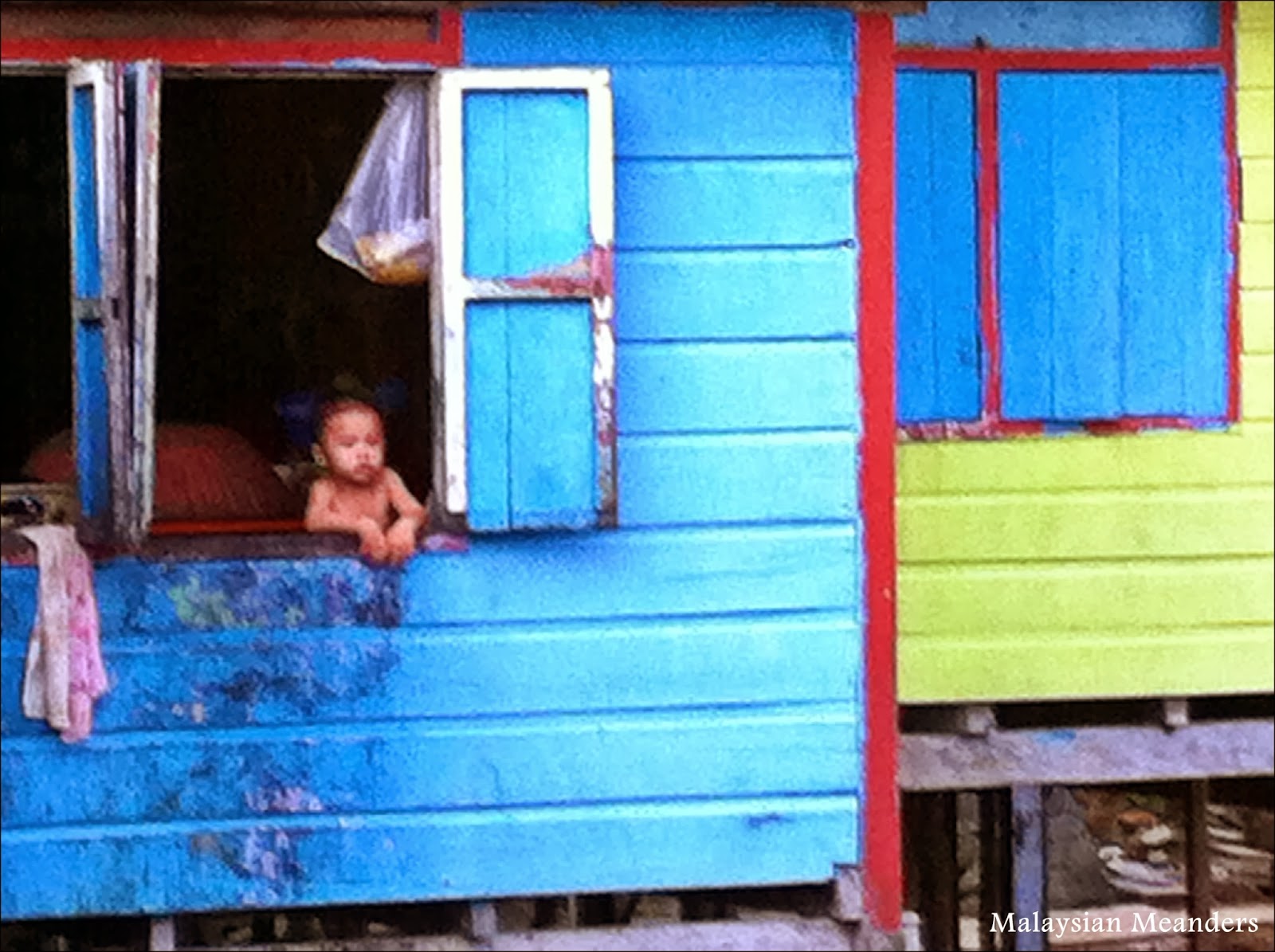
For me, one of the best parts of our river excursion was stopping at a Malay fishing village. The brightly painted houses were raised up on stilts to keep them out of the way of rising water. Boats were tied up all along the shore.

Santubong, Sarawak, Borneo
The fishermen have returned home for the day.

This place is so remote that they are not hooked up to a power utility. Instead, the loud drone of gasoline powered electric generators filled the air as we pulled up. There's a small school to serve the younger children, but teens interested in getting an education had to go elsewhere for classes, only coming home on weekends.

Santubong, Sarawak, Borneo
Toddler boy hanging out the window over the water.

The lack of power and secondary schools made me realize how different my life was compared to this fishing society. After all, I had reached their village on a 3-hour pleasure cruise and was going to lay my head down to sleep in a lovely hotel in Kuching that night. The fishing families, on the other hand, did not have the economic means to travel this distance often. Their poverty keeps them isolated.

Santubong, Sarawak, Borneo
However, they do have the money for satellite television.

The evening call to prayer was just about go out as we landed, so most of the footpaths were empty as wandered through the village. In fact, we never saw a man the whole time we were there as they were off praying. I did see a Winnie-the-Pooh baby blanket hanging up to dry, though.

Santubong, Sarawak, Borneo
Wooden walkways between homes lead down to the river.


Santubong, Sarawak, Borneo
One little boy dressed up in his Friday finery. 


Santubong, Sarawak, Borneo
The fanciest house I saw in the village.

We only spent a few minutes walking around. I actually felt a bit odd taking photos, wondering what I would think if some stranger stood a few feet from my home taking pictures of it.

Santubong, Sarawak, Borneo
Sunset from the fishing village

As the sun began to set, we got back on board for our return trip. The guide shone his powerful flashlight at the mangrove forest's shoreline, sweeping its beam back and forth. He was looking for crocodiles whose eyes reflect the light, making them glow in the dark. My girl was the only person to see a crocodile (or so she claims).

We ended the evening cruise floating by a couple trees filled with fireflies blinking on and off. Fireflies are pretty much impossible to photograph in the dark from a bobbing boat. While I remember seeing fireflies on summer nights when I was a kid, this is the first time that my own children have seen them. I wonder if the fireflies are dying off in Houston, Texas as my parents still live in my childhood home, and the fireflies no longer flit through their yard.

All of us were quiet on the 40-minute van ride back to Kuching. It's excursions like this that make me fully appreciate all that travel can show my family. Wildlife transforms from being something we read about in books or visit in captivity to something that we see in its natural habitat. We're introduced to people whose society is physically located close to our own modern world yet remains so different from ours. We weren't just flipping through a copy of National Geographic. We were experiencing it in real life.


IF YOU GO:
We booked our tour through CPH Travel Agency. They picked us up from our hotel in Kuching in an air conditioned van and provided fruit snacks and non-alcoholic beverages on the cruise as part of the tour. The boat had life-jackets if you elected to wear one, even ones small enough for preschoolers. The cost was a little more than US$50 for adults and US$25 for children.

RELATED POST:
Don't Anger the Orangutans


This post is part of Travel Photo Thursday on Budget Travelers Sandbox, "Oh the Places I've Been" on The Tablescaper, Sunday Traveler on Ice Cream and Permafrost, and Travel Photo Mondays on Travel Photo Discovery. Check them out form more around-the-world travel inspiration.
Web Analytics